How I Reverse-Engineered Exterm-An-Ant: A DIY Ant Bait Clone
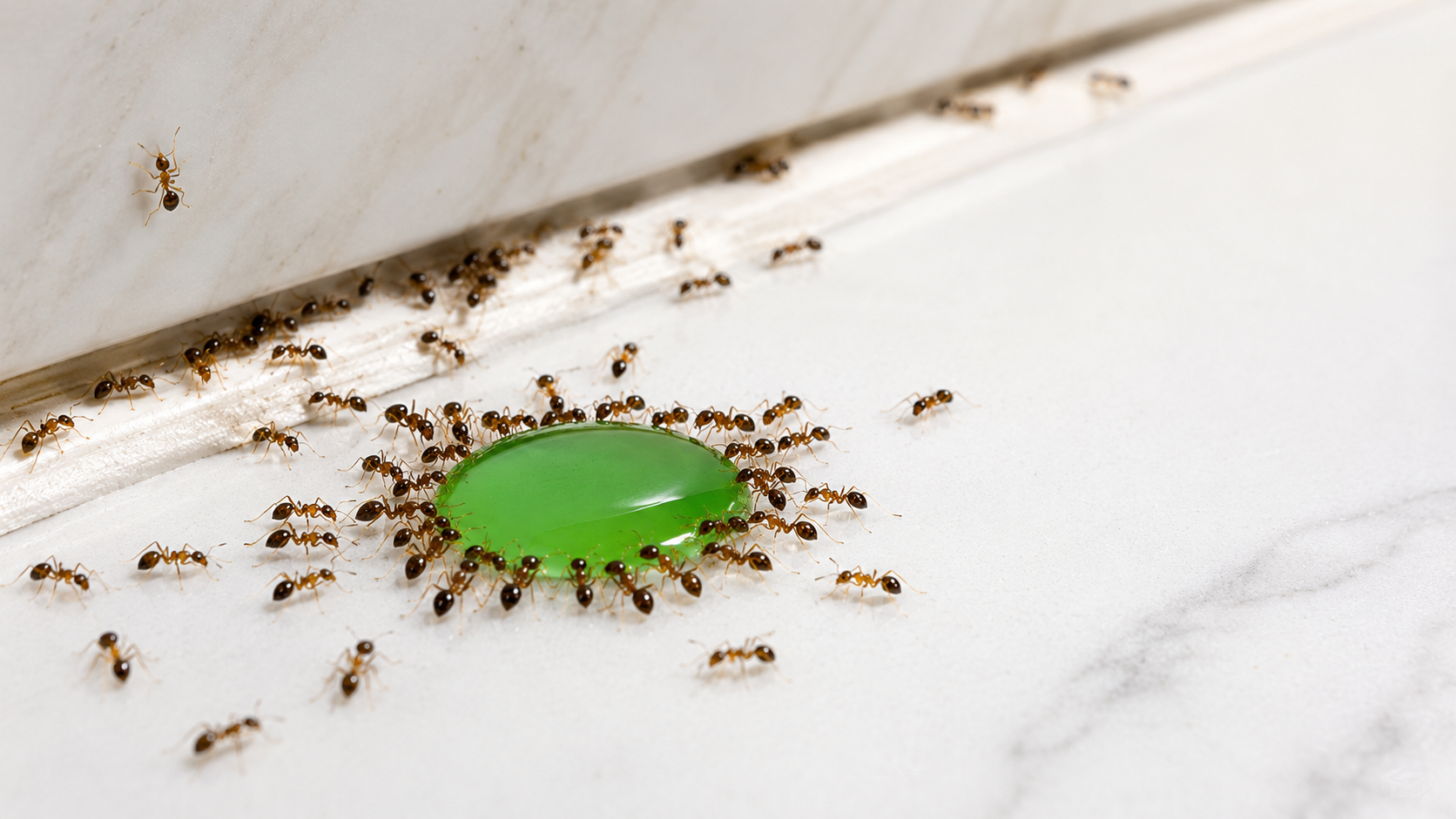
When I have a product works suspiciously well, I want to know why. Exterm-An-Ant, the green liquid borate ant bait you'll find behind a lot of New Zealand kitchen kickboards, is one of those products. So I set out to reverse-engineer it from publicly available documents, rebuild it on my kitchen bench, and understand the chemistry that makes a "boring" sugar-and-boron bait outperform fancier neurotoxin gels.
This article has the clone recipe, the detective work that got me there, and an honest account of what I could prove versus what I had to estimate.
Disclaimer: this is a personal-curiosity and home-use project. Borates are a suspected reproductive toxicant. My homemade version is not a regulated product and carries none of the food-safety approvals the commercial one does. Full safety and legal notes are at the bottom, so please read them before mixing anything.
What Is Exterm-An-Ant, Exactly?
Exterm-An-Ant is a ready-to-use liquid ant bait made by Tasmex Ant Labs. Unlike fast-acting neurotoxin baits, it's built around borates (boric acid and sodium borate) dissolved in a sweet carbohydrate solution. The borates are the active ingredient; the sugar is the delivery vehicle that gets ants to drink it and carry it home.
What makes it interesting is that it punches above its weight. In a peer-reviewed Argentine ant study, it was the second most lethal bait tested out of five, beaten only by a fipronil product, and under the right conditions it wiped out entire lab colonies, queens included. For a bait whose "secret" is essentially boron and sugar, that's a great result, and exactly the kind of thing that made me want to take it apart.
It also helps to know the target. Argentine ants are a widespread invasive species that spread through New Zealand after arriving around 1990, and their diet leans heavily on liquid sugars like honeydew and nectar. That sweet tooth is the whole reason a sugar-based liquid bait works so well on them: a carbohydrate carrier matches exactly what they already forage for, and their habit of sharing food mouth-to-mouth means a toxin picked up by a single forager can spread to hundreds of nestmates it never directly touched.
Why Clone It Instead of Just Buying It?
Three honest reasons. First, cost and volume: if you're treating a big recurring ant problem, mixing your own borate bait is dramatically cheaper per litre. Second, tunability: once you understand the formula, you can dial the concentration up or down for your situation. Third, the satisfaction of actually understanding your pest control instead of trusting a green bottle on faith. Reverse-engineering it turned a mystery product into a recipe I can reason about.
How I Backed Out the Formula
This is the part I find genuinely fun, so let me walk through exactly how I got from "green liquid in a bottle" to a working recipe.
Start With the Document Manufacturers Are Forced to Publish
The single best resource for reverse-engineering any chemical product is its Safety Data Sheet (SDS). By law, the SDS has to disclose hazardous ingredients and their concentrations. Exterm-An-Ant's SDS is unambiguous in its composition section:
- Boric acid: 80 g/litre (8%), CAS 10043-35-3
- Sodium tetraborate pentahydrate (sodium borate / "borax"): 56 g/litre (5.6%), CAS 12179-04-3
- Everything else, listed only as "proprietary balance"
So right away, two of the three pieces fell out for free. The SDS also told me the product is a green, odourless liquid at roughly 1 g/cm³, a detail that turned out to matter a lot later.
Cross-Check Against Independent Research
I never trust a single source, so I went looking for the product in the scientific literature, and found it. A 2012 Journal of Economic Entomology study on Argentine ants describes Exterm-An-Ant in its own words: a liquid carbohydrate bait containing 8% boric acid and 5.6% sodium borate in a sweet carbohydrate solution.
That independent description matched the SDS numbers exactly. When a legally mandated disclosure and a peer-reviewed paper agree on the same figures, you can be confident you've got the active ingredients right. Two of three boxes ticked, verified twice.
Confront the One Thing I Couldn't Prove (the Sugar)
Here's where honesty matters. The sweetener concentration is never disclosed anywhere. The SDS lumps it into that "proprietary balance," and the research paper only ever calls it "a sweet carbohydrate solution." No number exists in any public document I could find.
So I tried to triangulate it from the one quantitative clue I had: density. The SDS lists specific gravity at about 1 g/cm³. Sugar raises density noticeably, roughly +0.04 for every 10% sucrose by weight. A 25% sugar syrup on its own already sits near 1.10 g/cm³, and that's before adding 136 g/L of borates. Taken at face value, a density of ~1.0 implies a fairly low sugar load.
There's an important caveat, though: that density figure is itself unreliable. The 136 g/L of dissolved borates alone should already push the product to around 1.05, yet the sheet still rounds it to ~1.0. That tells me the "~1 g/cm³" is a loose "it's basically a watery liquid" entry, not a careful measurement. SDS density values for dilute aqueous products are notoriously approximate.
My honest conclusion: the real sugar content is genuinely unknown, the density hint leans low, and, crucially, for making a bait that works the exact figure barely matters. Argentine ants love sucrose, and anywhere from about 10% to 25% is highly palatable. So I treat sugar as the one adjustable variable in the recipe.
Why 8% Boric Acid Shouldn't Work, But Does
The last piece was understanding a real tension. The classic ant-bait literature says boric acid works best at 0.5 to 1%, because higher concentrations become repellent: ants taste them and stop feeding. Exterm-An-Ant uses eight times that. By the textbook, it should fail.
The reconciliation taught me more than the recipe did:
- Boron is intrinsically slow. Unlike neurotoxins that kill in hours, borates act over days regardless of dose, so workers still survive long enough to share the bait with the colony, the queen included.
- The borax is doing palatability work. Pairing boric acid with sodium borate buffers the solution toward neutral, making it far less repellent than 8% boric acid alone would be.
- Liquid spreads fast. Argentine ants drink liquids much quicker than they eat gels, so a sugary liquid distributes through a nest rapidly.
- Hunger overrides caution. In the study, the bait only achieved total colony kill when ants were starved for 48 hours. At 24 hours it underperformed. Starved ants feed aggressively and force-feed each other, steamrolling any mild repellency.
In other words, the high-concentration formula is excellent under the right conditions: small-to-moderate colonies and hungry ants. That single insight reshaped how I use the bait, which I'll come back to.
The DIY "Exterm-An-Ant" Clone Recipe
Here's the formulation I settled on for a 1 litre batch.
| Ingredient | Amount | Notes |
|---|---|---|
| Boric acid powder | 80 g | Matches the 8% active level |
| Borax (sodium tetraborate pentahydrate) | 56 g | Matches the 5.6% |
| White sugar (sucrose) | 100 to 250 g (10 to 25%) | The unknown; lean low to match the original's thin consistency, high for max palatability |
| Green food colouring | a few drops | Purely cosmetic |
| Warm water | to make up to 1 L |
Substitution tip: if you only have common decahydrate borax (the everyday laundry kind), try about 73 g instead of 56 g, because decahydrate carries more water weight, so you need more to deliver the same boron.
Method
- 700 mL of warm water.
- Stir in the sugar until fully dissolved.
- Add the borax and stir until clear. It dissolves slowly, so keep the water warm.
- Add the boric acid and stir until dissolved. Boric acid and borax together form a borate buffer and stay in solution more happily than either does alone.
- Add the colouring, top up to the 1 litre line, and let it cool.
Dispense a few millilitres onto cotton wool, into sealed bait stations, or in shallow caps along ant trails.
How to Get the Best Results
The science above translates into three practical levers:
- Starve the ants first. Remove competing food (crumbs, spills, pet bowls, and especially any aphid or honeydew sources outside) for a day or two before baiting. Hungry colonies take up far more bait.
- Keep it liquid. The fast trophallaxis of a liquid bait is a big part of why this formula reaches queens. Don't let it dry out.
- Be patient. Boron kills over days, not minutes. Seeing live ants on the bait is good: it means they're carrying it home. Expect colony decline over one to two weeks, not overnight.
Placement matters as much as the mix. Put small amounts at several points directly on the trails you can see ants using, rather than one big puddle in the middle of the floor, and top up the spots that get the most traffic. Resist the urge to spray or wipe out the visible ants while the bait is working, because the foragers walking the trail are precisely the ones ferrying the dose back to the nest. Check the stations every couple of days and refresh any that have dried out or been emptied, since a dried bait stops recruiting.
What to Expect After You Deploy It
The first day or two can feel like nothing is happening, or even that the problem got briefly worse as more ants discover the new food source and recruit others to it. That surge is normal and is actually the bait doing its job, because heavy recruitment means more of the colony is being fed. Over the following week you should see trails thin out, then overall activity drop away as the nest declines from the inside. If numbers still haven't fallen after about two weeks, the usual culprits are a competing food source you haven't removed, bait that dried out before it spread, or simply a colony large enough to need a second round, rather than a fault in the formula itself.
Safety and Legal Notes (Please Don't Skip This)
This is a real pesticide so treat it like one:
- Borates are classified Category 2 (H361, suspected of damaging fertility or the unborn child). Wear gloves while mixing, and if you're pregnant or trying to conceive, have someone else handle it or skip the project.
- Keep it away from children and pets.
- It is not the regulated product. The commercial Exterm-An-Ant carries specific MPI and AsureQuality approvals for use in farm dairies and food-processing premises. This recipe is for home and garden use only; if you need the regulatory status (for example in a commercial food setting), buy the approved product.